
Fuhuza
The coca plant is a small shrub native to the Andean regions of Bolivia, Peru, and Colombia. For thousands of years, Indigenous peoples have used its leaves for medicinal, nutritional, and spiritual purposes. Traditionally, chewing coca leaves or drinking mate de coca provides a mild stimulant effect that reduces fatigue, hunger, and thirst, while also helping the body adapt to high altitudes. The leaves are rich in minerals such as calcium, potassium, and phosphorus, as well as vitamins B1, B2, C, and E, and dietary fiber. They have also been used to ease digestion and stomach ailments and may influence carbohydrate and fat metabolism.
Recent scientific studies have shown the coca leaf’s complex nutritional and biochemical profile. Chemical analyses reveal that the leaves contain more than 50% insoluble fiber, natural sugars, organic acids, polyphenols, and flavonoids—compounds known for antioxidant properties. A controlled human study found that coca-leaf chewing alters energy metabolism by increasing the body’s use of fatty acids without significantly changing heart rate or blood pressure. Reviews also suggest possible benefits for digestion, motion sickness, and glucose regulation; however, the evidence remains preliminary and limited by legal restrictions on coca research. For the Muysca people of Suba, in Bogotá, Colombia, coca embodies the word and knowledge of their ancestors, who have walked their territory, connecting the sacred word, thought, and heart.
Erythroxylum coca
Erythroxylum novogranatense
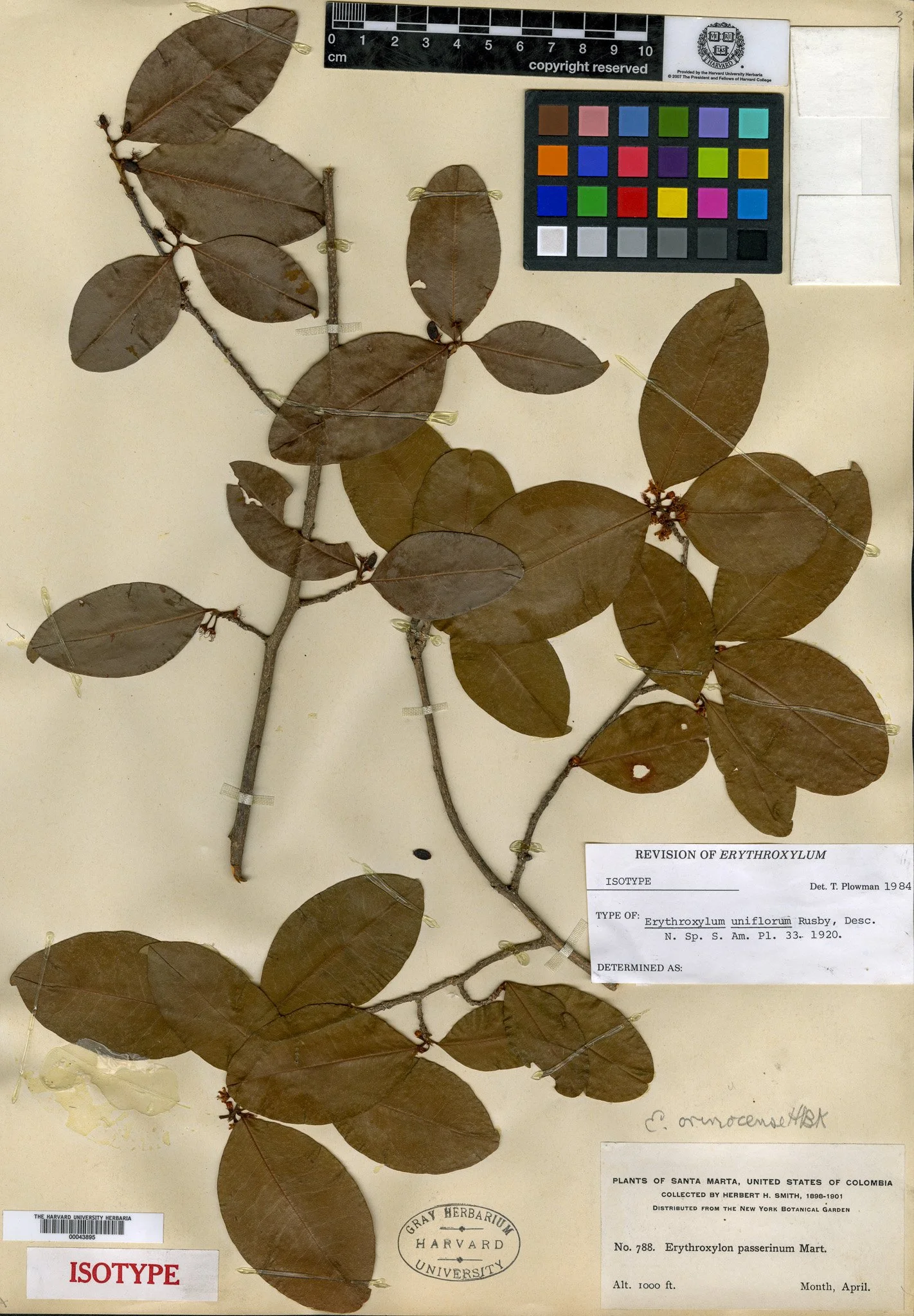
Smith, 1898. Erythroxylum uniflorum.
References
Barreto, Ivan Farias. “O uso da folha de coca em comunidades tradicionais: perspectivas em saude, sociedade e cultura” [The use of coca leaves in traditional communities: perspectives in health, society, and culture]. Historia, ciencias, saude--Manguinhos vol. 20,2 (2013): 627-41. doi:10.1590/s0104-59702013000200015
Bauer, Irmgard. “Travel medicine, coca and cocaine: demystifying and rehabilitating Erythroxylum - a comprehensive review.” Tropical diseases, travel medicine and vaccines vol. 5 20. 26 Nov. 2019, doi:10.1186/s40794-019-0095-7
Biondich, Amy Sue, and Jeremy David Joslin. “Coca: The History and Medical Significance of an Ancient Andean Tradition.” Emergency medicine international vol. 2016 (2016): 4048764. doi:10.1155/2016/4048764
Casikar, V et al. “Does chewing coca leaves influence physiology at high altitude?.” Indian journal of clinical biochemistry : IJCB vol. 25,3 (2010): 311-4. doi:10.1007/s12291-010-0059-1
Dillehay, Tom D., Jack Rossen, Donald Ugent, Anathasios Karathanasis, Víctor Vásquez, and Patricia J. Netherly. “Early Holocene Coca Chewing in Northern Peru.” Antiquity 84, no. 326 (2010): 939–53. https://doi.org/10.1017/S0003598X00067004.
Lopez-Chau, L A et al. “Traditional coca chewing and cortisol modulation in Andean miners: A pilot quasi-experimental repeated-measures study on stress physiology at high altitude.” Journal of ethnopharmacology vol. 355,Pt A (2026): 120630. doi:10.1016/j.jep.2025.120630
Marentes-Culma, Ronald et al. “From Tradition to Science: Chemical, Nutritional, and Cytotoxic Characterization of Erythroxylum coca from Indigenous Colombian Communities.” ACS omega vol. 10,15 15009-15017. 14 Apr. 2025, doi:10.1021/acsomega.4c10491
Plowman, Timothy. “The Ethnobotany of Coca (Erythroxylum Spp., Erythroxylaceae).” Advances in Economic Botany, vol. 1, 1984, pp. 62–111. JSTOR, http://www.jstor.org/stable/43931370. Accessed 13 Nov. 2025.
Sauvain, Michel, C. Rerat, C. Moretti, E. Saravia, S. Arrazola, E. Gutierrez, A. M. Lema, and V. Muñoz. 1997. “A Study of the Chemical Composition of Erythroxylum coca var. coca Leaves Collected in Two Ecological Regions of Bolivia.” Journal of Ethnopharmacology 56 (3): 179–191.
Weil, A T. “The therapeutic value of coca in contemporary medicine.” Journal of ethnopharmacology vol. 3,2-3 (1981): 367-76. doi:10.1016/0378-8741(81)90064-7
Herbarium Specimen Reference
Smith, H. H. (1898). Erythroxylum uniflorum Rusby — isotype (specimen #00043895). Collected April 1898 near Santa Marta, Magdalena, Colombia, 304 m elevation (collector no. 788). Harvard University Herbaria (GH). Barcode: 00043895. GUID: http://purl.oclc.org/net/edu.harvard.huh/guid/uuid/eb2fa87d-6af6-4c48-9a62-245436fbe850. Verified by T. Plowman. Phenology: flower. Preparation: pressed sheet.
“When we prepare mambe—toasted coca leaf mixed with a bit of yarumo and lime—we eat it, and it nourishes us with trace elements: calcium, iodine, magnesium, potassium. The alkaloid in coca itself helps alleviate ailments like arthritis.
But beyond that, we say the true medicine in mambe is the thought of the elders who have walked the territory. We create medicine to find the spirit. The word, the wisdom of the elders, and the feeling of Mother Earth awaken in us the knowledge that already lives within each one of us.
Mambe, through word, thought, and heart, draws a line between us. Mambe is fire—it awakens that inner flame. Some might say it opens the chakras, but for us, it awakens our very essence. That is where the power of spiritual medicines begins.
These medicines awaken in each of us that cosmic element, that residue of creation, to bring it back to life, to awaken the Word again, and to guide it toward ancestral wisdom. That is why we seek the sacred plants—they are the path back to knowledge.” (Yeison Yopasa, Muysca Zaita (traditional doctor and knowledge keeper)).